
Market View - 4th Quarter 2026
“A plunging Japanese yen has Washington taking one of its rarest financial actions in years. After the US joined Japan in a rare effort to buy Japanese yen and support the struggling currency, Treasury Secretary Scott Bessent said the Trump administration would do “whatever it takes” to keep supporting the yen. He added that the US would support Japan “in a way that helps the American economy, the American taxpayer.” The joint intervention, the first coordinated US-Japan effort to support the yen since 2011, comes after the Japanese currency sank to roughly 40-year lows of around ¥164 per US dollar, before rebounding to about ¥156 following Friday’s intervention.”- MSN Moneywise, 21st August,
LAST QUARTER REVIEW
At its September meeting of the Federal Open Markets Committee (FOMC), the Fed unanimously raised the target range for the federal funds rate by 0.25% to 3.75% – 4.00% as expected, marking the first-rate hike since 2023. Policymakers noted that inflation remains elevated, and updated projections showed that 16 of 18 officials see the possibility of at least one more 0.25% rate hike later this year with four pencilling in two additional rate increases.
The Fed now expects GDP to expand in 2026 at 2.3% (2.2% previously expected) and at 2.4% in 2027 (2.3%), while it expects core inflation in 2026 to increase at 3.4% (3.3%) and in 2027 at 2.5% (2.5%). The unemployment rate is now projected at 4.1% in both 2026 (4.3%) and 2027 (4.3%).
Long term interest rates edged upwards with the US 10-Year Treasury Note breaching 5% during September, the first time since 2007, and ending September at 5.3%, reflecting the market’s inflationary concerns because of the potential energy crisis caused by the protracted war in the Middle East. This has impacted bond returns with the S&P US Treasury Bond index returning -2.44% for the quarter and -1.92% year to date.
Wall Street equity indices, however, continued to set new records during the quarter with the S&P 500 and Nasdaq 100 before closing at 7751.54 and 30408.50 respectively. In currency markets, the dollar remained strong closing at 101.50 when measured against the DXY, a basket of other currencies.
The Bank of England (BoE) Monetary Policy Committee (MPC) voted 6–3 to keep Bank Rate unchanged at 3.75% at its September meeting. The MPC said the prolonged conflict in the Middle East has pushed crude and refined energy prices higher contributing to a rise in UK CPI inflation to 3.1% in August, with further increases expected in coming quarters.
The MPC said there is limited evidence of significant second-round effects on wages and prices, although the risk could increase if energy costs remain elevated. The MPC also unanimously agreed to reduce its stock of government bond purchases to zero through a multi-year programme, unwinding holdings at an average annual pace of £46 billion through 2034.
Long term interest rates hit their highest levels since 2008 as the benchmark 10-year gilt yield surged through 5% ending September at 5.4% reflecting the inflationary concerns surrounding energy. However, the FTSE 100 (made up primarily of globally focused companies with international earnings) ignored concerns climbing 1.04%, while the domestically focused FTSE 250 and FTSE SmallCap indices did better, rising 6.63% and 3.70% respectively.
In the Eurozone, the European Central Bank (ECB) raised its key interest rate by 0.25% to 2.65% at its September meeting, marking its second hike since the US-Iran war began. The ECB said the conflict continues to fuel inflationary pressures, with inflation expected to remain well above its 2% target for an extended period.
The ECB kept its 2026 inflation forecast at 3.0% but revised its projections higher for 2027 and 2028, to 2.5% and 2.1%, respectively. GDP projections were upgraded to 0.9% for 2026 and 1.4% for 2027, while long term interest rates throughout the eurozone increased with Germany’s 10-year Bund yield reaching 3.65% in late September, its highest level since June 2009.
The People’s Bank of China (PBOC) kept its key lending rates at record lows for a 16th straight month in September, including the one-year loan prime rate (LPR), the benchmark for most corporate and household borrowing, at 3.0%, while the five-year LPR, a reference rate for mortgages, remained at 3.5%.
China’s Q2 GDP growth eased to its lowest level since Q4 2022, although exports remained strongly supported by AI-related demand. New yuan loans extended rose in August, following the sharpest contraction on record in July, while housing prices continued to decline reflecting persistent weakness in the property sector.
The Bank of Japan (BOJ) raised its key short-term rate by 0.25% to 1.25% in a 7-2 vote at its September meeting, taking borrowing costs to their highest level since April 1995 as the BOJ expects inflation to remain above the 2% target in the coming years, with analysts forecasting price growth to approach 3% by early next year. The hike came just three months after the previous increase, the shortest interval between hikes since 1990, and followed increased pressure from Washington, including calls from US Treasury Secretary Scott Bessent for higher rates.
The price of both West Texan Intermediate (WTI) and Brent crude oil rose dramatically from around $70 and $80 to more than $105 and $110 in Mid-September, due to fears for insufficient supply to meet the global economy’s needs, before both eased slightly quarter end on renewed Middle East peace talks. Gold bullion meanwhile was volatile as it rose from around $4,000 an ounce to more than $4,600 before closing September at $4,152.
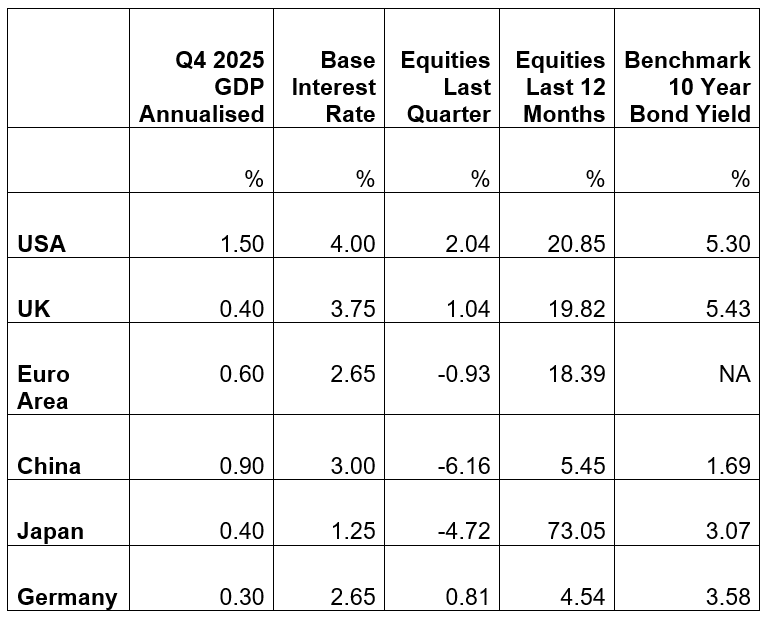
GDP Data shown are to the 30th of June 2026; Interest Rate, Equity & Sovereign Benchmark Bond Yield Data are to the 30th of September 2026; Equity Indices used: US – S&P 500, UK – FTSE 100, Eurozone – Euro Stoxx 50, China – Shanghai Shenzhen CSI 300, Japan – Nikkei 225, Germany – Xetra Dax; Benchmark Sovereign Bond Yield Data courtesy of Trading Economics.
CURRENT CONSIDERATIONS
In our last commentary, we observed that “with the Middle East conflict between the US and Iran seemingly moving to a peaceful settlement and oil beginning to flow more freely through The Strait of Hormuz, investors will be hoping the threat of US interest rates increasing will recede and the focus will once more turn to reducing them as was the case pre-conflict.”
Unfortunately, we were premature in our expectations that the Middle East conflict was about to be resolved. Sadly, traffic through the Strait of Hormuz remains a tiny percentage of what it was before hostilities began seven months ago, with on average fewer than five ships a day according to independent sources compared to nearer sixty pre-March.
Analysts estimate that between 6 million and 13 million barrels a day less oil has been delivered from Saudi Arabia and other Middle East oil exporters since the 1st March due to the Strait being severely impacted by the conflict. According to data released in August by Saudi Aramco, the national oil company of Saudi Arabia, as much as 2.6 billion barrels of oil has failed to make global markets, together with 20% of global liquid natural gas (LNG), a third of the world’s fertilisers and 9% of its aluminium, due to the Strait remaining largely unnavigable.
In Mid-September, the conflict took another turn for the worse following the attack by Iranian terrorist proxies on the Saudi Arabian east west pipeline that takes oil to ports on the Red Sea for export via the Suez Canal or out into the Indian Ocean. Prior to this attack some of the oil that had previously been exported through the Strait of Hormuz in the Gulf had been successfully diverted through the east west pipeline and via Saudi’s Red Sea ports exported northwards through the Suez canal.
The option for tankers to head south from these western Saudi Arabian ports and reach their destinations which were often Asian markets like China via the shortest route is, most days, not an option due to the Iranian backed Houthi terrorists based in Yemen attacking ships as they negotiate the narrow Bab al-Mandeb strait. Most tankers therefore had been taking the longer route via the Suez canal, the Mediterranean Sea and around Africa, thereby adding two to three weeks in journey time and costing more in energy used.
The good news at least for now is that according to an article in the Saudi press concerning the east west pipeline on the 27th September, “the Saudi oil infrastructure affected by earlier attacks has been repaired and returned to full capacity, restoring a key export route that supports global crude supply flows.” However, the article cautions, “earlier attacks that prompted temporary disruptions were part of a broader pattern of asymmetric threats targeting energy facilities in the region that have included drone, and missile strikes attributed to non-state actors or regional proxies.”
Meanwhile to add to the energy woes of the United States, despite being one of the world’s largest producers of fossil fuels, still needs to import additional oil to satisfy its growing economy, a major failure in the power grid of Illinois on the 14th September resulted in the ExxonMobil Joliet oil refinery having to be shut down.
The resulting loss of 11 million gallons a day of diesel and gasoline accounting for around 6% of Mid-West USA supply, has caused diesel and gasoline prices in this region to soar. At the end of September this facility remained incapacitated, with no confirmed date for restarting refining.
Not surprisingly, some market commentators are suggesting that it is extraordinary the oil price is still only around $100! Additionally, the world’s second biggest producer of oil, Russia who until recently exported 40% of their oil, are now a net importer of gasoline and diesel following the success of Ukrainian drone attacks on some of their major refineries and ports.
The global energy shortages are causing concerns about Japan’s economy. Last quarter saw an unprecedented joint intervention in the currency markets by the United States and Japan authorities to limit the fall of the yen which had fallen to almost 164 to the dollar, a 40-year low.
Trying to ensure the dollar yen exchange rate remains relatively stable is essential for the stability of the global economy especially as Japanese debt has reached an unprecedented 260% of GDP. That makes the US government debt to GDP ratio of 120% look like a storm in a teacup by comparison.
The combined intervention last quarter cost around $40 billion and halted the decline but our concern is for how long? The yen carry trade which has proved profitable for banks, hedge funds and other traders for decades, now looks vulnerable.
The yen carry trade is estimated to involve anywhere between $10 and $18 trillion and is based on borrowing in yen where interest rates are low (indeed until recent years 0%) and exchanging these for dollars before investing in US Treasuries, Wall Street equities, and / or whatever other securities the speculative investor expects to appreciate. This has proved such a profitable trade over the past few decades that many speculators have added leverage, to increase the original stake by between 10 and 100-fold according to some sources.
Mostly, during the past several decades, the yen carry trade has proved incredibly profitable, but problems occur if the currency exchange rate stability begins to collapse. Unless stability is quickly restored, margin calls on leveraged positions begin to accumulate and potentially lead to a collapse that becomes self-feeding, prompting forced sales of other securities (whose values also decline) to meet those margin calls, much as we saw during the Great Financial (sub-prime mortgage) crisis when financial markets fell like dominoes as liquidity disappeared.
No one knows for certain the precise extent of the yen carry trade and suggestions of between $10 and $18 trillion could be vastly underestimated as the estimated total value of the global derivates market is between $2 and £4 quadrillion (or between $2,000 and $4,000 trillion). This is more of a concern today than during previous scares in the yen carry trade such as June 2024.
If the BOJ prints more yen as they have been doing for years, inflation will destroy their economy unless they raise interest rates, which they have now reluctantly done (at the behest of the US Treasury Secretary), but doing this could potentially exacerbate the collapsing yen trade. Additionally, because Japan imports 97% of its energy, the increased energy costs due to the Middle East war has made the yen carry trade more precarious than ever before.
Back in June 2024, the exchange rate moved above 160 yen to the dollar, but that wobble was stabilised relatively easily by the authorities purchasing yen in the markets – however, not before the Japanese stock market fell almost 10% before recovering.
With oil now regularly trading at around $100 a barrel or more and with the potential to spike higher, it could be tempting for Japan to sell some of the US Treasuries it owns to facilitate its energy demand which of course would not sit well with America which has its own debt funding problems, now more than $40 trillion for the first time in history. Oil prices are likely to remain elevated as long as the Strait of Hormuz through which around 20% of global oil was being transported remains closed.
Despite promises from President Trump back in March that the war with Iran would be over in two or three weeks, it is now more than seven months since the conflict began. In addition to oil tankers being unable to travel safely through the Strait of Hormuz, attempts by Saudi Arabia to ship oil from its western coast through the Red Sea are regularly interrupted by drone attacks on both shipping and Saudi oil ports by Houthi rebels based in Yemen who recently seized the whole southern coastline bordering the Red Sea and now control the narrow Bab al-Mandeb Strait
FORWARD OUTLOOK
We feel that we could possibly be approaching an inflection point for global markets. Whilst the odds are that, for now at least, the American and Japanese authorities will be able to contain any fallout from the yen carry trade, the risks have greatly increased. Those increased risks will remain until the shipment of oil from the Middle East returns to normal, and the cost of energy returns to pre-Iran war levels of around $60 a barrel compared to currently around $100 or more.
This is, however, beginning to look increasingly unlikely in the short term; indeed, we could see the oil price spike further as countries chase a diminished supply to satisfy demand. Despite being a major oil producer, the United States is currently unable to meet its energy needs alone and has already used up much of its strategic reserve which has now fallen to a 44-year low!
Additionally, Russia, which, until recently, has exported as much as 40% of its oil is now a net importer. Art Berman, an oil analyst with decades of experience has recently commented “The Iran War looks less like another geopolitical crisis and more like a phase shift for industrial civilizations”.
“It took decades to recover fully from the oil shocks of fifty years ago – adapting to a disruption of similar magnitude today may be far more difficult. Global energy growth is structurally weaker, financial shock absorbers have been heavily used, international institutions are more fragmented, and the global economic system operates at a vastly greater scale and complexity.”
Despite the continuing geopolitical headwinds, markets have, so far, shown remarkable resilience; largely as a result of robust and steady earnings growth and the possibility that ongoing major conflicts can be resolved before causing real damage to the global economy.
Whilst we remain cautiously optimistic that earnings can continue to grow into 2027, we continue to advise a defensive investment approach with regard to portfolio allocations and will be keeping a close watch on events over the coming months for any sign of significant shift in market sentiment.
As always, maintaining a well-diversified and balanced portfolio remains key whilst also ensuring that our client’s shorter-term capital and income needs are secured without risk.
Copyright © Ash-Ridge Asset Management 1st October 2026.
Data Sources: Bank Of England; Bloomberg; Brookings Institute; Columbia Threadneedle Investments; CNBC; Economic Cycle Research Institute; European Central Bank; Financial Times; Hoisington Investment Management; Macrotrends: Macro Voices; Office for National Statistics; S&P Indices; The Economist; The Federal Reserve; The National Bureau of Economic Research; Trading Economics; UK Debt Management Office; US Debt Clock.org; US Department of The Treasury; Wall Street Journal; Yahoo Finance: Yes I Give A Fig Thoughts On Markets – Mike Green Substack.
Our testimonials
I first met Anthony Kynaston some 13 years ago, when I sought advice regarding an inheritance from my late parents. He immediately impressed me with his friendly, calm, clear and professional manner, ascertaining my individual needs. Tony has since then continued to advise, plan and manage my financial affairs. This includes advice on my Buy to Let property and pension needs. He and his colleagues are always available to assist with any queries I may have. As a result, I can relax and now enjoy my retirement, leaving the complexities of financial management in their safe hands.
Ash-Ridge has provided myself and my family with friendly, professional financial advice for many years. I find them trustworthy and reliable, and would not hesitate to recommend them.
I have been working with Tony and Andrew at Ash-Ridge to manage my financial affairs for several turbulent years since 2007. They have supported me with a variety of significant decisions and administration relating to pensions and investments while dealing with ever-changing circumstances as I moved into retirement. I am very happy to work with them, and to recommend their services.
Ash-Ridge have been managing my personal pension investment portfolio for two years. I can say that I am absolutely delighted with the professional way they have handled my assets offering solid and independent advice which has been prudent and reliable. Dealing with an experienced team with first class communication and speed of response when advice is required. They are a pleasure to deal with.
Sophie and I just wanted to thank you again for all your help in remortgaging. As ever, the service was superb and efficient, we will of course be coming back!
We have been using Jane at Ash-Ridge for the last 10 years, which literally speaks volumes for the service we receive. Jane’s honest and straightforward approach is a key part in ensuring we get the deal that is best for us. She is swift and always keeps us updated throughout the entire process whilst allowing us sufficient time to make a final decision. Jane is a first class mortgage adviser and I would recommend her to anyone seeking mortgage or financial advice.